Spandex – properties, use and processing in clothing production
Spandex is one of the most important fibres in the modern clothing industry. Whether sportswear, swimwear or underwear – hardly any elastic garment today can do without this fibre content. The term spandex fabric does not refer to a standalone fabric, but to a blended fabric that contains varying amounts of the fibre after which it is named. Spandex is particularly important in sewing sportswear, where stretch, freedom of movement and shape retention are essential. In this article, we explain what spandex is, which properties distinguish the fibre, how manufacturers process it in textile production, and what you should consider when purchasing and caring for spandex fabrics.
What is spandex and what is the material made from?
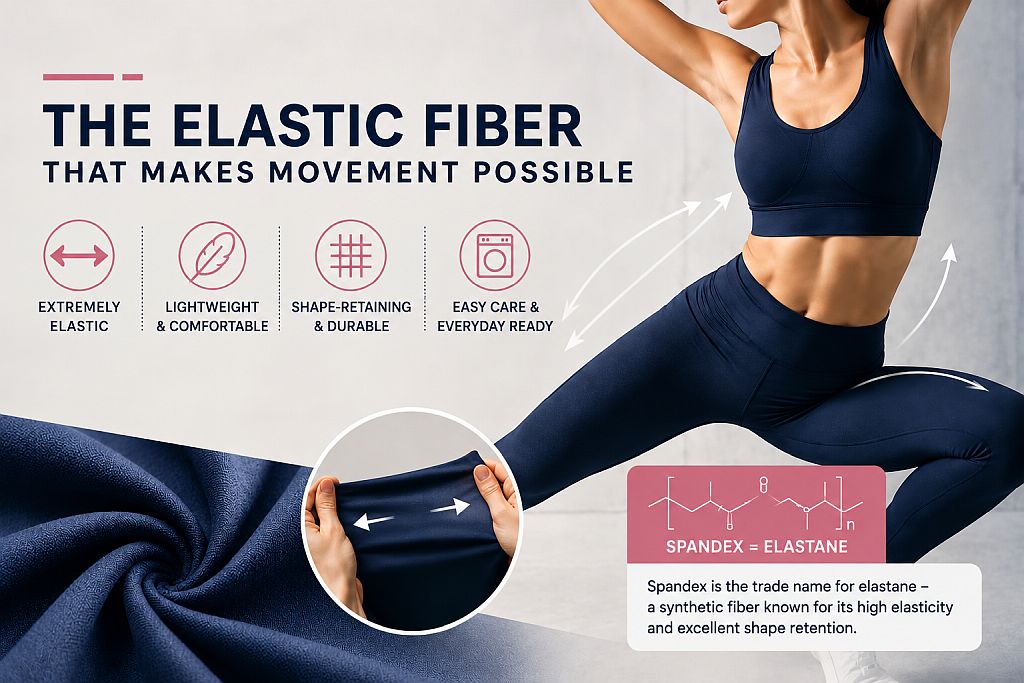
Spandex is the trade name commonly used in North America for a synthetic fibre that contains at least 85 percent polyurethane. In Europe, manufacturers usually call the same material elastane, while DuPont originally introduced Lycra as a brand name that is also frequently used as a synonym. Technically, all three terms refer to the same fibre; only the name differs depending on the region and manufacturer.
Spandex manufacturers produce the fibre as a so-called filament yarn: the individual fibres join together to form a continuous thread without requiring twisting. The molecular structure consists of alternating hard and soft segments, where the soft segments are responsible for the characteristic stretchiness and the hard segments ensure the recovery force. This combination makes the fibre one of the most elastic materials processed in the textile industry.
Since its market launch in 1959, spandex fabric has established itself in virtually all areas of clothing production – from simple everyday clothing to technical sportswear.
What properties distinguish spandex?
The central property of spandex is its exceptional stretchiness: depending on the type, the fibre can stretch to five to eight times its original length and then reliably return to its original shape. Some sources even speak of a stretchiness of 500 to 700 percent for certain fibre types. This recovery force clearly distinguishes spandex from other elastic materials such as rubber threads, which lose their tension more quickly after repeated stretching.
Further characteristic properties are:
- Low moisture absorption: Spandex absorbs only around one percent of its own weight in moisture, which makes the material quick-drying.
- Chemical resistance: The fibre is insensitive to salt water, cosmetics, skin oils and perspiration.
- High tear resistance: Compared to conventional rubber, spandex is not only more stretchable but also significantly more durable and resistant to mechanical stress.
- Good dyeability: Manufacturers can dye spandex without difficulty, enabling uniform colouring in blended fabrics.
These properties make the fibre an ideal supplementary material; however, manufacturers almost never process it in pure form and instead add it to other fibres.
How is spandex incorporated into fabric?
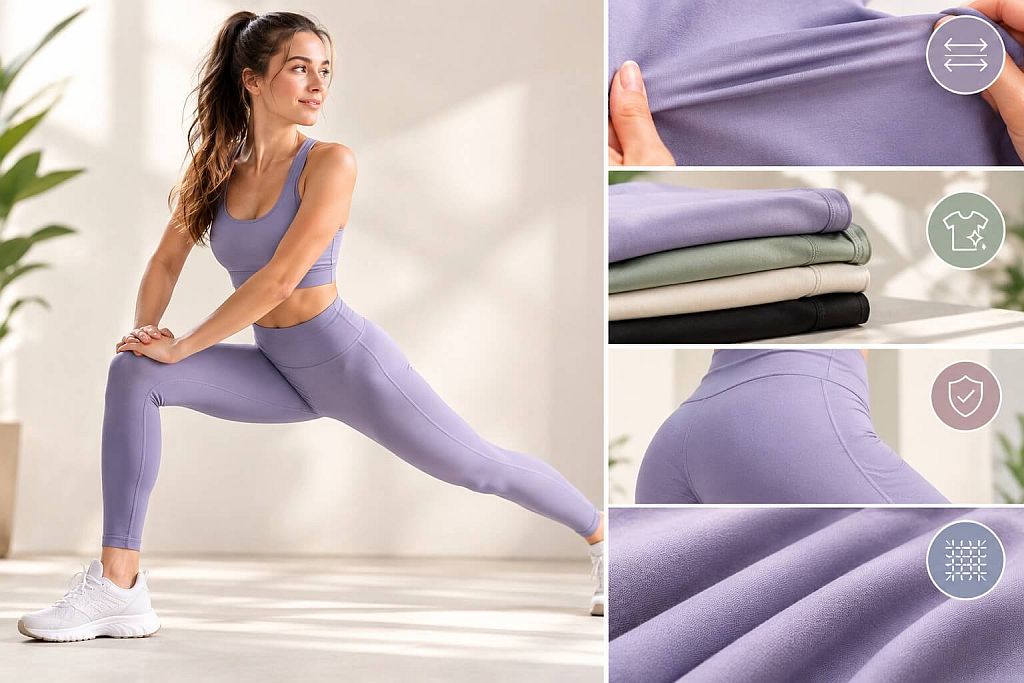
In practice, manufacturers rarely use pure spandex fabric. Instead, they combine the fibre with other materials – such as cotton, polyamide or polyester – to complement their properties. The proportion of spandex in a blended fabric is usually between 2 and 40 percent, depending on the desired degree of elasticity.
During processing, manufacturers either twist the spandex fibre directly with the other yarns using the core-spun method or introduce it into the fabric as a separate weft or warp thread. Both methods make it possible to direct the stretchiness specifically into one or more directions of the fabric – a principle used, for example, in 4-way stretch materials for sportswear and swimwear. For a swimwear manufacturer, this controlled elasticity is particularly important, as the fabric needs to follow the body closely while still allowing sufficient freedom of movement.
How much a spandex blended fabric ultimately stretches therefore depends not only on the fibre content itself, but also on the chosen weave and bonding technique.
Spandex content in comparison – how many percent does each garment need?
The ideal spandex content differs considerably depending on the garment, since different applications place different demands on stretchiness and shape stability.
| Garment | Typical spandex content | Purpose |
|---|---|---|
| T-shirts, trousers, everyday clothing | 2–5% | Shape stability, reduced tendency to crease |
| Underwear | 5–10% | Fit, comfortable feel |
| Sportswear | 10–20% | Freedom of movement, recovery force |
| Swimwear | 15–25% | Stretchiness, shape retention in water |
| Foundation garments, shapewear | Up to 40% | Maximum compression and support |
This overview shows that the closer-fitting and more functional a garment is, the higher the spandex content generally needs to be. When developing products, it is therefore worthwhile determining the fibre content not across the board, but specifically for the respective product category.
Advantages of spandex blended fabrics for clothing production
For brands and sewing workshops, processing spandex fabric offers several concrete advantages over pure natural fibre or standard fabrics.
First and foremost is shape stability: garments with a spandex content retain their original fit even after frequent wearing and washing, as the fibre gives the fabric a permanent recovery force. This goes hand in hand with a reduced tendency to crease – a practical advantage particularly for travel and everyday clothing that should require little care.
Wearing comfort also improves noticeably: even small spandex contents of two to five percent ensure that fabrics adapt to body movement rather than remaining rigid. For movement sequences such as sport or everyday activities, this means less restriction and more freedom of movement.
Finally, spandex can extend the durability of a garment: the fibre withstands mechanical stress better than many other elastic materials, helping garments maintain their shape and performance for longer. This makes it particularly relevant for high-quality and functional product lines.
Limitations and weaknesses of spandex
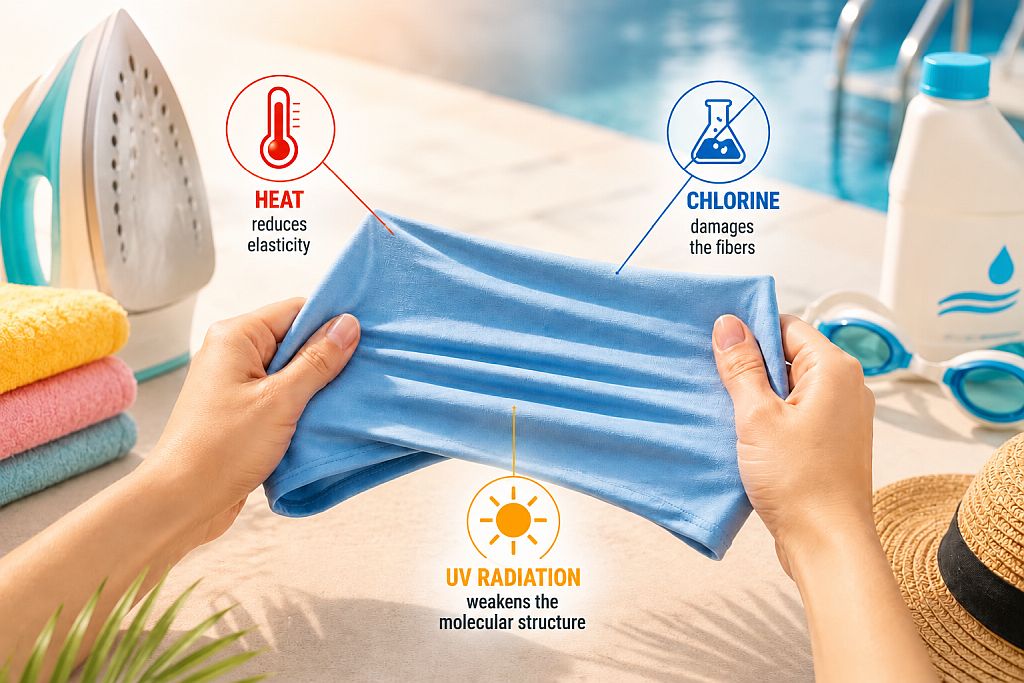
Despite its advantages, spandex has certain weaknesses that manufacturers should realistically consider during product development. Sensitivity to heat is perhaps the most important point: spandex does not tolerate high temperatures well. At washing temperatures above 60 degrees Celsius or when ironing with too much heat, the fibre permanently loses its elasticity, which manifests as stretched-out, loosely fitting garments.
Chlorine exposure is another critical factor, particularly for swimwear. Although spandex is fundamentally insensitive to salt water, regular and intensive chlorine contact attacks the fibre over time and accelerates the loss of elasticity. This is especially relevant when developing swimwear in line with current swimwear trends, where fit, shape retention and long-lasting performance remain important product requirements.
UV radiation also affects the fibre with prolonged exposure: intensive and repeated sunlight can weaken the molecular structure, which in the long term results in diminishing tension and slight yellowing.
These weaknesses do not mean that spandex is unsuitable for the corresponding applications. However, manufacturers should select an appropriate fibre quality and, if necessary, a higher spandex content for products exposed to high levels of chlorine, heat or UV radiation to achieve the desired durability.
What should one pay attention to when purchasing spandex blended fabrics?
When sourcing spandex fabric for series production, several technical criteria are worth examining, as they significantly influence the later product quality.
- Grammage: The weight per square metre of the fabric should match the planned area of application – lightweight sportswear requires a different weight than robust shapewear. When choosing a fabric for sportswear, grammage also affects the garment’s feel, breathability and overall performance during movement.
- Spandex percentage: The actual fibre content should always match the technical product description, and manufacturers should select the appropriate percentage for the intended use.
- Material quality and origin: Not every spandex fibre is of equal quality – differences in quality between manufacturers directly affect durability and recovery behaviour.
- Stretch tests: Manufacturers should test the fabric on a sample piece before series production to assess its stretchiness and recovery force – for example, by stretching it repeatedly and observing how quickly and completely it returns to its original shape.
- Compatibility with further processing steps: Manufacturers should check whether printing or coating affects the elasticity of the spandex content in the fabric.
Careful examination of these points during the sample phase considerably reduces the risk of later complaints.
Care instructions for clothing with a spandex content
For garments with a spandex content to retain their elasticity for as long as possible, correct care is essential.
When washing, a low temperature of 30 to a maximum of 40 degrees Celsius is recommended. Higher temperatures damage the fibre structure and lead to a noticeable loss of elasticity. Manufacturers should always avoid chlorine-based bleaching agents, as these directly attack the chemical structure of spandex and permanently weaken the fibre.
Manufacturers should avoid tumble drying garments with a high spandex content whenever possible, as the heat generated in the dryer is one of the most common causes of premature elasticity loss. Air drying in the shade is the gentler alternative. The same applies to ironing: use a low temperature setting and, where possible, iron the affected fabric area only indirectly through a cloth in order not to expose the fibre to direct heat.
Passing on these care instructions in product communications to end customers can noticeably extend the lifespan of garments and significantly reduce the number of complaints due to loss of shape.
Conclusion – spandex as a versatile fiber for modern clothing
Spandex is particularly useful when a garment needs to provide elasticity, freedom of movement and reliable shape retention. Even small amounts of the fiber can significantly change the properties of a fabric, which is why Spandex is combined with cotton, polyester, polyamide or other fibers depending on the intended application.
For clothing production, the focus should therefore not be on using the highest possible Spandex content, but on finding the right combination of fiber content, fabric construction and intended use. While a few percent may be sufficient to improve comfort and shape retention in everyday clothing, sportswear, swimwear and shapewear require considerably greater elasticity.
Proper processing and subsequent care are equally important. Exposure to excessive heat, chlorine or intense UV radiation can accelerate the loss of elasticity. Careful material selection and testing during the sampling stage therefore provide the foundation for durable and functional garments.
FAQ – Frequently asked questions about spandex fabric
Yes, in the technical sense they are the same fibre. Lycra is a registered brand name of DuPont for elastane, while spandex is the general trade name used mainly in North America. In textile production, both terms are frequently used interchangeably.
Pure spandex fabric would be unsuitable for garments, as the fibre alone offers insufficient stability, surface structure or appearance. Only in combination with cotton, polyamide or polyester does a fabric emerge that is both elastic and suitable for everyday use.
A simple test helps: stretch the fabric repeatedly and observe how quickly and completely it returns to its original shape. If the fabric returns only slowly or incompletely, this indicates a lower fibre quality or too low a spandex content.
Yes, like any fibre, spandex is subject to a natural ageing process. With proper care – low washing temperature, no chlorine bleach, no tumble dryer – this process can however be considerably slowed down and the lifespan of the garment noticeably extended.
To a limited extent. Spandex tolerates occasional chlorine contact well, but with regular and intensive exposure – such as daily swimming training – elasticity diminishes more quickly. For such applications, a higher spandex content and a chlorine-resistant fibre quality are recommended.