Swimwear Trends 2026 – Colors, Cuts and Materials for the New Season
The swimwear trends 2026 are clear: sustainability is no longer a niche topic, colors are becoming bolder, and cuts finally allow for more body diversity. Anyone planning a collection for the new season as a fashion brand, designer, or swimwear manufacturer should know where things are heading – both aesthetically and in terms of materials and production. This overview shows which trends truly matter in 2026 and what they mean for swimwear manufacturing.
The most important swimwear trends 2026 at a glance
2026 does not bring a revolution, but rather a clear evolution of what has been emerging over recent seasons. Sustainability, inclusion, and conscious style are moving to the forefront – while at the same time color and a sense of joy are making a comeback.
The key impulses of the season come from four directions:
- trend colors with character
- cuts designed for real bodies
- ecologically responsible materials
- eye-catching prints
Anyone who incorporates these impulses into their collection will capture the spirit of the time.
Swimwear Trend Colors 2026 – from earthy tones to bold contrasts
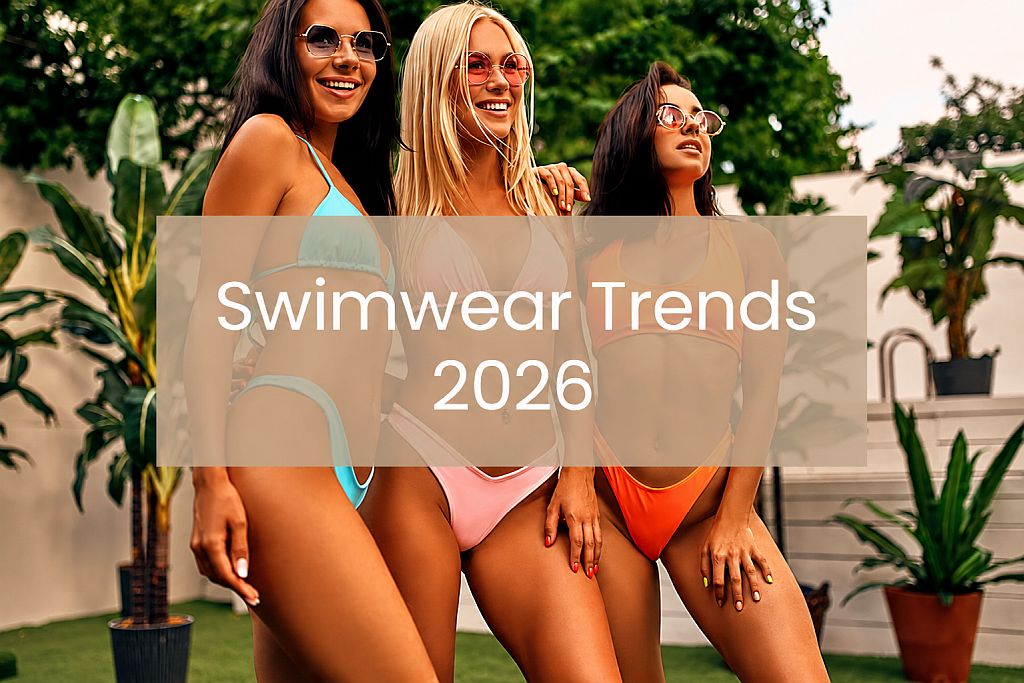
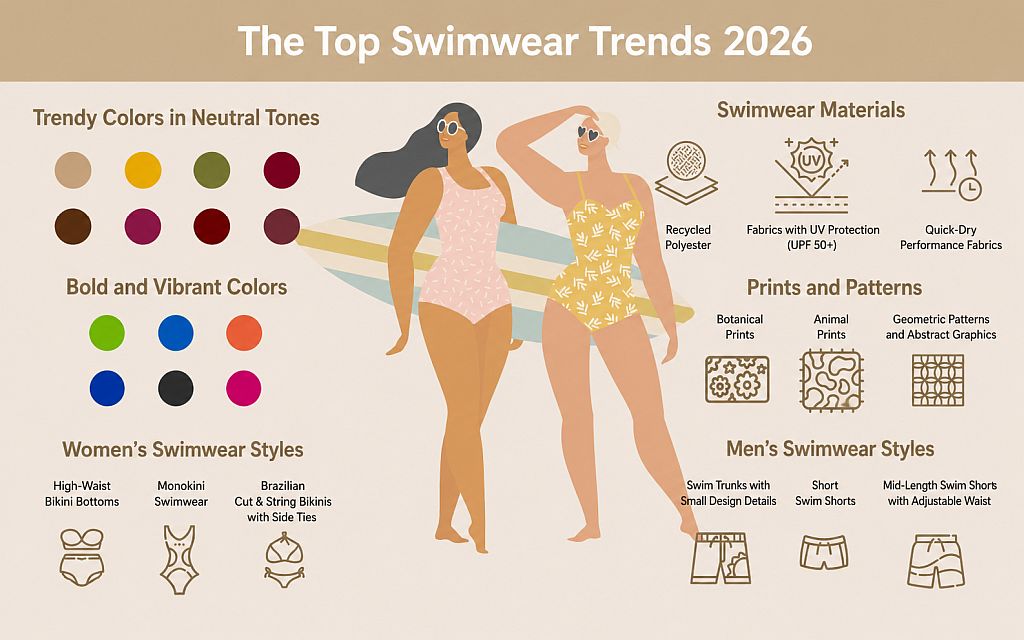
The color palette for the 2026 season thrives on contrasts, and that is exactly what makes it so exciting. On the one hand, warm, earthy tones dominate: chocolate brown, desert beige, yellow, and olive green. These colors feel timeless, pair well with natural materials, and appeal to a target group that values quality over short-lived trends. Deep red is also considered a key trend shade this year: burgundy, wine red, berry tones, and deep Bordeaux.
Swimwear trend colors for 2026 also include modern shades such as blue, pastel tones, earth-inspired hues, and neon colors in women’s swimwear.
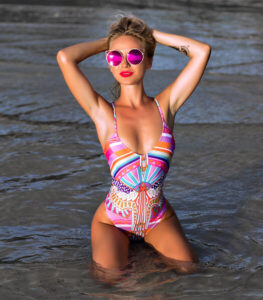
On the other hand, the season strongly embraces bold accent colors: lime green, electric blue, cobalt blue, bright coral, and sharp magenta, alongside classic black. These tones work especially well as highlights – for straps, ties, or contrasting seams. The trend does not move in one single direction, but rather in two: either subtle and understated or bold and expressive.
Which cuts dominate swimwear in 2026? Trend silhouettes
In terms of cuts, 2026 shows a clear development in two directions: minimalist, timeless basics meet striking statement designs. Classic shapes such as simple one-piece swimsuits with deep back cuts, bandeau bikini tops, or swim briefs with clean, straight leg openings remain relevant and stand out for their versatility and easy styling.
At the same time, modern asymmetrical details are gaining strong importance. One-shoulder tops, diagonal cuts, or uneven strap designs create a dynamic, contemporary look without appearing overdesigned. In the women’s segment, figure-enhancing and character-driven silhouettes are becoming especially popular – from high-waist bikinis in a vintage style to Brazilian and string bikini variations with side ties, as well as elegant monokinis.
Men’s swimwear is also evolving toward shorter, more body-hugging silhouettes. Instead of long board shorts, mid-length swim shorts with a slimmer leg opening are in focus, complemented by shorter styles and designs with subtle details such as contrast stitching or logos.
| Area | Trend cuts 2026 |
|---|---|
| General shapes | Minimalist basics such as one-piece swimsuits, bandeau bikinis, and classic swim briefs meet modern statement silhouettes. |
| Asymmetrical designs | One-shoulder tops, diagonal cuts, and uneven straps create a modern, dynamic look. |
| Women’s fashion | High-waist bikinis in a vintage style, Brazilian and string cuts, as well as elegant monokinis are especially in demand. |
| Men’s fashion | Shorter, tailored swim shorts, more fitted cuts, and designs with contrast details or logos are trending. |
Sustainable materials – the trend that is here to stay
Sustainability is no longer a “bonus selling point” added on top – it has become an expectation that customers have toward fashion brands. Especially in swimwear, which is exposed to chlorine, salt water, and sunscreen, material choice plays a double role: it determines both durability and environmental impact.
One of the leading materials of the season is Econyl – a relatively young, sustainable alternative to conventional nylon. It is a regenerated polyamide made from recycled fishing nets, carpets, and industrial waste. It is just as elastic and durable as traditional polyamide, but has a significantly better environmental footprint.
Other material trends for the 2026 season include:
- Recycled polyester – a more affordable alternative to ECONYL, also made from plastic bottles or recycled materials
- Fabrics with UV protection (UPF 50+) – especially in demand for children’s swimwear and sporty collections
- Quick-drying functional fabrics – ideal for brands combining beachwear and activewear
An important production insight: not every fabric works for every cut. Stiffer materials support clean, structured shapes, while softer qualities adapt closely to the body. Anyone developing a new collection should always align material choice with the intended silhouette – and test samples before moving into full production.
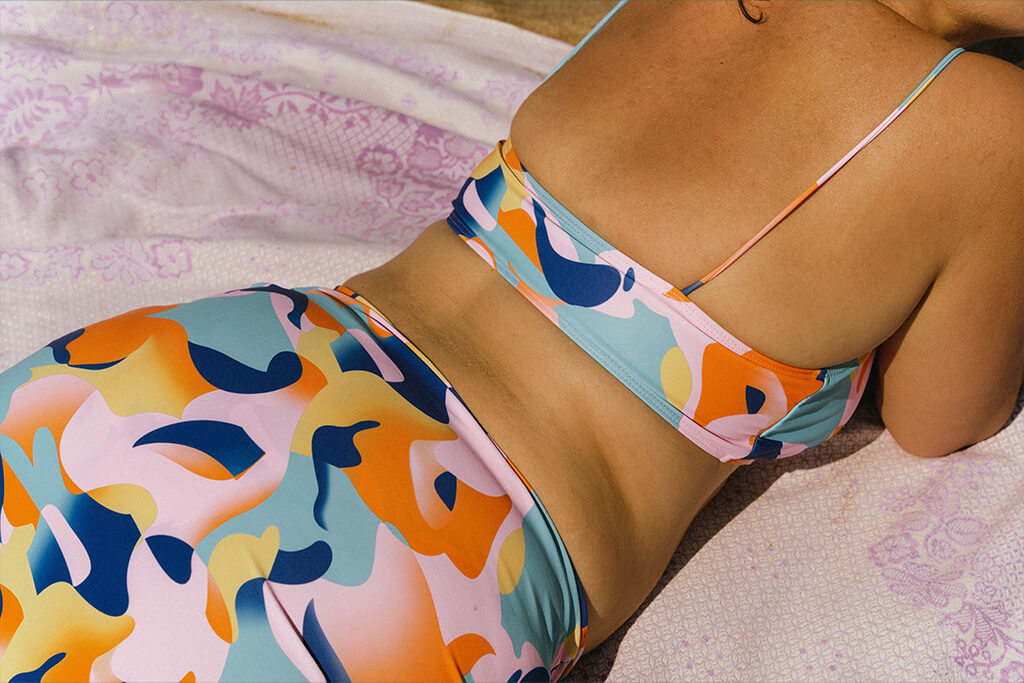
Prints and patterns – what will be trending in 2026?
Prints are experiencing a real renaissance in 2026, but with a new sense of confidence. The days of generic, mass-market floral patterns are over. What works now has a clear design identity.
- Botanical patterns remain strong, but they are becoming larger and more abstract – oversized tropical leaves, bold shapes, and deep green tones on dark backgrounds.
- Animal prints are making a comeback as well, but in muted, almost monochrome versions: leopard in beige tones, zebra in sand and white. The result feels more mature and refined than earlier interpretations of this trend.
- Geometric patterns and abstract graphics are also gaining importance, especially for collections aimed at a younger, design-oriented audience.
- Tie-dye remains present as a retro reference, but it is becoming more sophisticated: less neon intensity, more controlled and balanced color gradients.
From a production perspective, prints need to be planned early, as printed fabrics are usually pre-ordered or custom-produced. Brands working with their own designs and prints should allow sufficient lead time – and test pattern placement on the final cut already during prototyping to ensure accuracy.
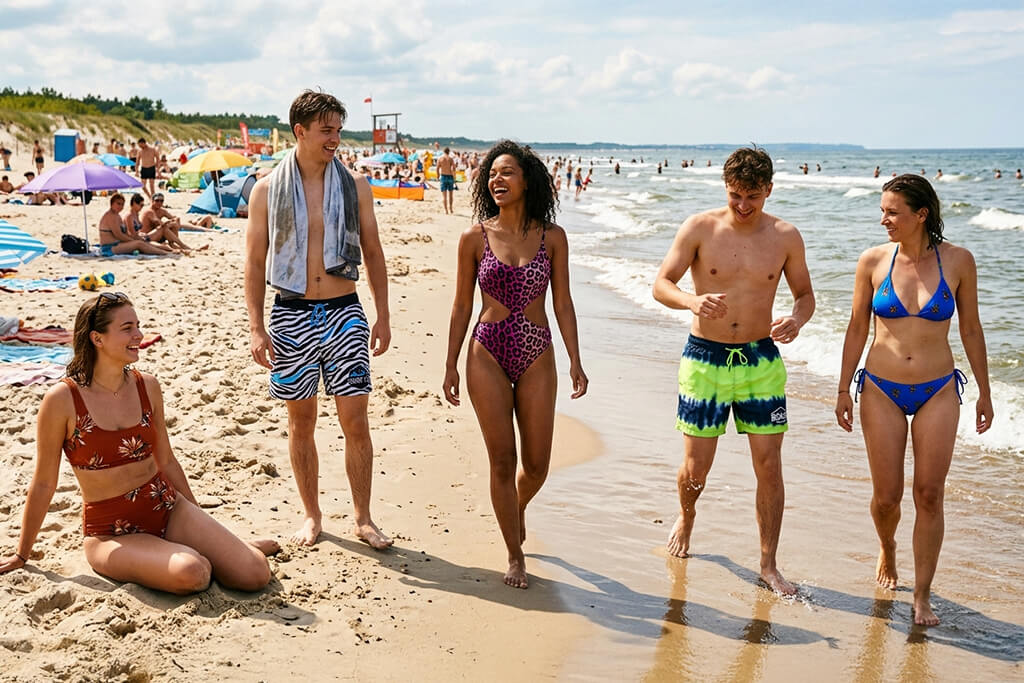
Inclusive swimwear – size diversity as a design principle
Inclusion in swimwear is no longer a niche – it is a growing market segment. Brands that consistently expand their size ranges and develop cuts that flatter different body shapes gain loyal customers who were long ignored. And these customers tend to remain highly loyal.
What does this mean concretely for design?
- First: cuts must truly be developed for larger sizes – not simply scaled up proportionally. A high-waist design that fits perfectly in size 36 will only work in size 48 if it has been specifically adapted. Wider straps, additional support seams, and adjusted leg openings are not extras, but essential requirements.
- Second: the size range should be considered from the very beginning – not added as an afterthought. Anyone producing a new collection should define the full size range already during the prototyping phase. This saves time, reduces revisions, and results in a collection that performs well across all sizes.
What do the 2026 trends mean for fashion brands and manufacturers?
Knowing trends is important, but the key question is how to translate them into a commercially viable collection. Especially in swimwear, timing, material selection, and production quality play a central role.
Topic – relevance for fashion brands and manufacturers
| Topic | Meaning for fashion brands & manufacturers |
|---|---|
| Early planning | Materials must be ordered in time, prototypes tested, and production capacity secured. The development process takes approx. 4–6 weeks after design approval. |
| Technical requirements | Swimwear requires elastic, high-quality materials as well as precise seam construction, correct tension, and high shape stability. |
| Choosing a production partner | Experienced manufacturers are crucial for the quality and durability of the collection – especially for technically demanding swimwear. |
| Production in Europe | Shorter supply chains, better communication, and faster adjustments in cuts, materials, or sizing are major advantages. |
| Advantage for start-ups | Small brands benefit from flexible production in Europe, ideal for compact first collections and fast market entry. |
For new brands, it is particularly important to choose a reliable production partner early on – ideally Cann Näherei – in order to ensure both quality and timing of the collection.
Latest swimwear trends – our conclusion
The swimwear trends 2026 provide clear direction for brands and designers: bold colors, well-thought-out cuts, sustainable materials, and genuine size inclusivity. Anyone who translates these impulses into a well-produced collection has the best conditions for a successful season. The key lies not only in design, but also in proper execution.
Anyone planning a swimwear collection for 2026 and looking for an experienced production partner in Europe will find the necessary expertise in specialized sewing manufacturers – from prototype development to final production.
FAQ – frequently asked questions about swimwear trends 2026 for brands and designers
Earthy, timeless tones such as chocolate brown or olive green combined with a clear accent color – for example cobalt blue or lime green – are a proven starting point. Add one or two cuts that work well across multiple sizes. Less is more: a small, well-thought-out collection is more convincing than many unfinished ideas.
Yes – the German market has clear preferences: quality, durability, and increasingly sustainability are highly valued. Brands that make these values visible in both design and communication have strong opportunities. Size inclusivity is also in higher demand here than in many other markets.
Focus on specialization – not every sewing manufacturer can handle elastic materials. Ask for reference collections, minimum order quantities, and lead times. Personal contact and short communication channels are especially important for the first collection, when many details still need to be clarified.
Yes, most specialized manufacturers work with customer-supplied or co-developed fabrics. It is important to test the print already on the pattern – the placement must work on the final garment already during prototyping, not only in production.
Shorter supply chains, faster response times for changes, and more direct communication are the main advantages. In addition, there is often greater transparency regarding production conditions and lower minimum order quantities. For brands that value “Made in Europe” or want to start with small batches, this is often the better choice.