Minimum Order Quantity (MOQ) in Garment Production – What Is Realistic?
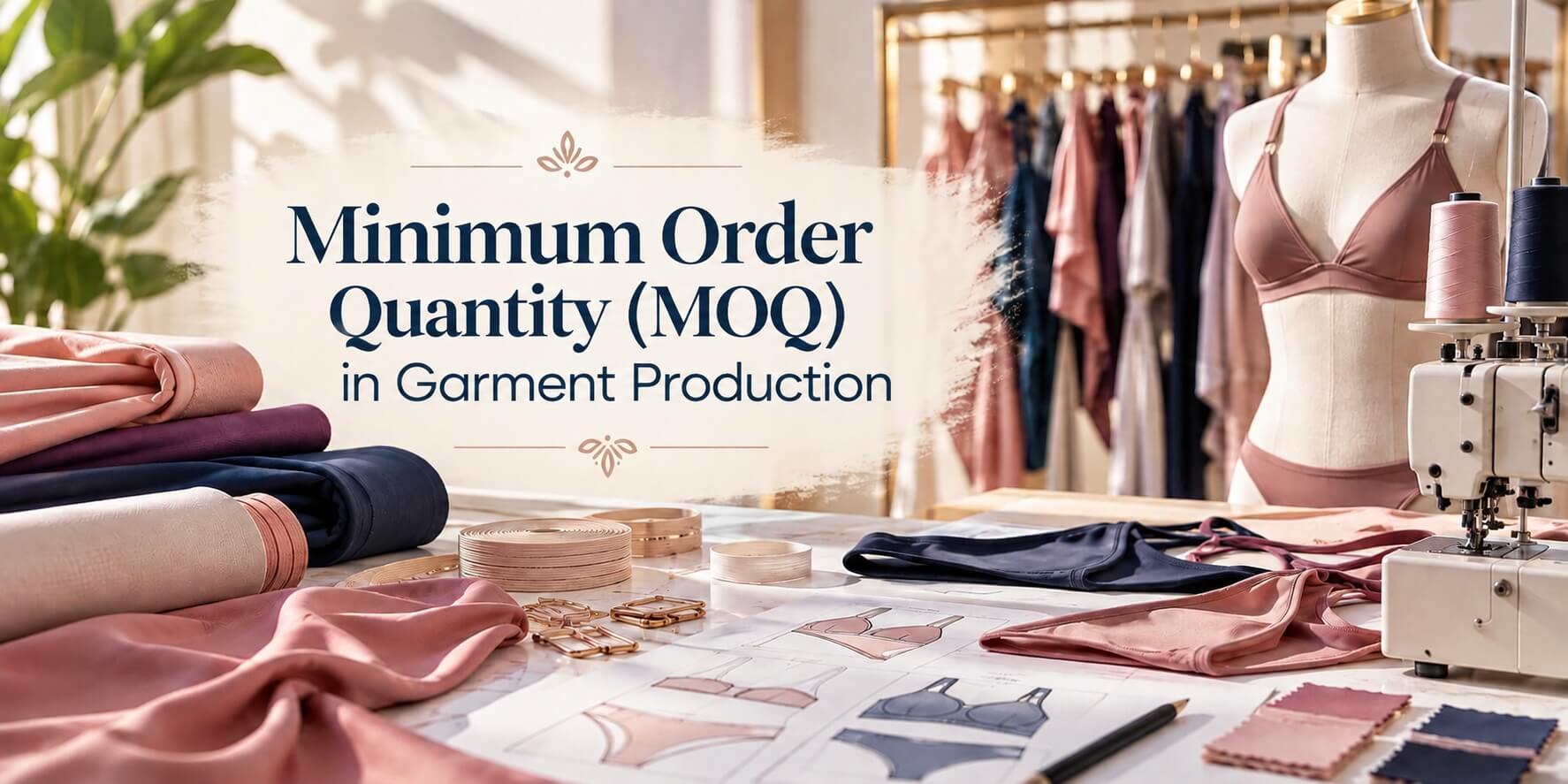
The minimum order quantity is the first hurdle for many brands when searching for a production partner. Anyone planning a collection wants to know: from how many pieces will a sewing factory accept an order – and what does that mean for budget and inventory? There is no one-size-fits-all figure, because the minimum order quantity depends on the product, the material and the production effort involved.
This article explains how it comes about, which quantities are realistic in practice, and how even young brands can enter garment production with a manageable test collection. As a Polish sewing factory with more than 25 years of experience, we know both sides: large series for established companies and first collections from start-ups.

What does minimum order quantity (MOQ) mean in garment production?
The minimum order quantity, MOQ for short, is the smallest number of pieces that a manufacturer produces in a single order. In garment production it is usually specified per model, and that is also the case at CANN.
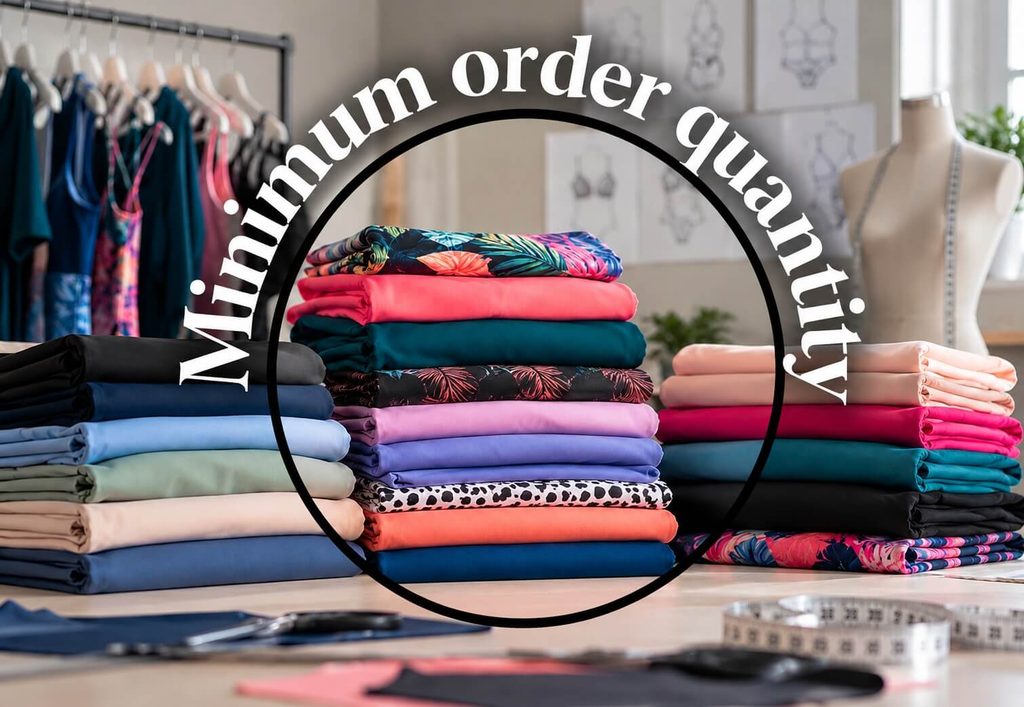
What matters is the exact reference unit. An MOQ of 100 pieces can refer to a model in total, to a single colour, or even to a single size. Depending on the definition, very different quantities end up in your warehouse. You should therefore clarify this point before comparing quotes.
Why sewing factories set a minimum order quantity
A minimum order quantity is not a form of harassment but the result of a sober calculation. There are four reasons behind it.
Preparation effort
Before the first production piece is sewn, pattern construction, a prototype, correction rounds and grading to all sizes are required. Whether 50 or 500 pieces are made afterwards changes little about this effort. The larger the series, the smaller the share of these fixed costs per garment.
Material use in cutting
In larger series, pattern pieces can be arranged more densely on the fabric. This reduces waste and saves material and costs.
Consistent quality
A series runs smoothly once the work steps have settled into a rhythm. The seamstresses know the model, and seams and measurements remain identical from the first to the last unit. Very small orders hardly allow this rhythm to develop. At CANN, technologists accompany every production phase – from material selection and sewing technique to finishing.
Plannable capacities
Every order ties up seamstresses, machines and cutting over a certain period. Minimum quantities ensure that this capacity is worthwhile and that delivery dates remain reliable.
Which minimum order quantity is realistic?
At CANN, the minimum order quantity is generally from 100 pieces per model. The exact value depends on the type of product and the desired series. This puts us in a range that is common in Europe: three-digit quantities per model are standard. Significantly smaller runs are sometimes possible, but they cost noticeably more per piece, until the unit prices approach the cost of sample pieces.
A simple example shows what this means for getting started: three models with 100 pieces each already add up to 300 pieces. If you plan ten models, you quickly end up at a thousand pieces – a volume that a young brand first has to sell.
Small series and large series: a rough guide
There is no binding definition. As a rule of thumb, up to a few hundred pieces per model counts as a small series, and several thousand pieces as a large series. CANN covers both ranges: from contract sewing for smaller and individual orders to industrial sewing for large series, where repeat accuracy and punctual delivery are crucial.
When a higher quantity is worthwhile
Larger quantities make sense when demand is predictable. Typical cases are basics and core products that run over several seasons, uniforms and workwear with a fixed demand within a company, and established brands with documented sales figures and regular retailers. For trend items and new models without sales data, on the other hand, a smaller initial series is the safer choice.
What influences the minimum order quantity?
Two orders with the same quantity can involve very different amounts of work. Five factors determine where the limit lies.
Product type
Each category brings its own requirements, which affect the set-up effort and thus the minimum order quantity:
- Underwear: many small individual parts, elastic materials and lace; a bra requires significantly more work steps than a simple T-shirt.
- Swimwear: special fabrics, lining and, depending on the model, padding that must be processed carefully.
- Sportswear: often knitwear with a high elastane content and a wide size range.
- Uniforms: clearly defined models in many sizes, often with recurring demand.
Material and accessories
Fabric suppliers also set minimum purchase quantities, for example for yard goods, lace, elastic bands or fastenings. For specially dyed or printed fabrics, these quantities are often higher. We advise you on the selection of fabrics, knitwear and accessories so that material and planned quantity fit together.
Pattern and workmanship
Elaborate patterns, many individual parts or special sewing techniques extend the set-up time. Elastic materials and knitwear require additional know-how – this is one of our strengths.
Colours, sizes and variants
Every additional colour means different material, separate cutting and a changeover of the machines. The size range affects grading and cutting layouts. The more variants a model has, the more important the question of how the minimum quantity is distributed across them.
Starting point of your project
If finished patterns and technical documentation are available, production starts faster. If we start from a photo or a drawing, we take over the construction and the prototype. This means more development work, but for young brands it is often the practical route.
Minimum order quantity and unit price
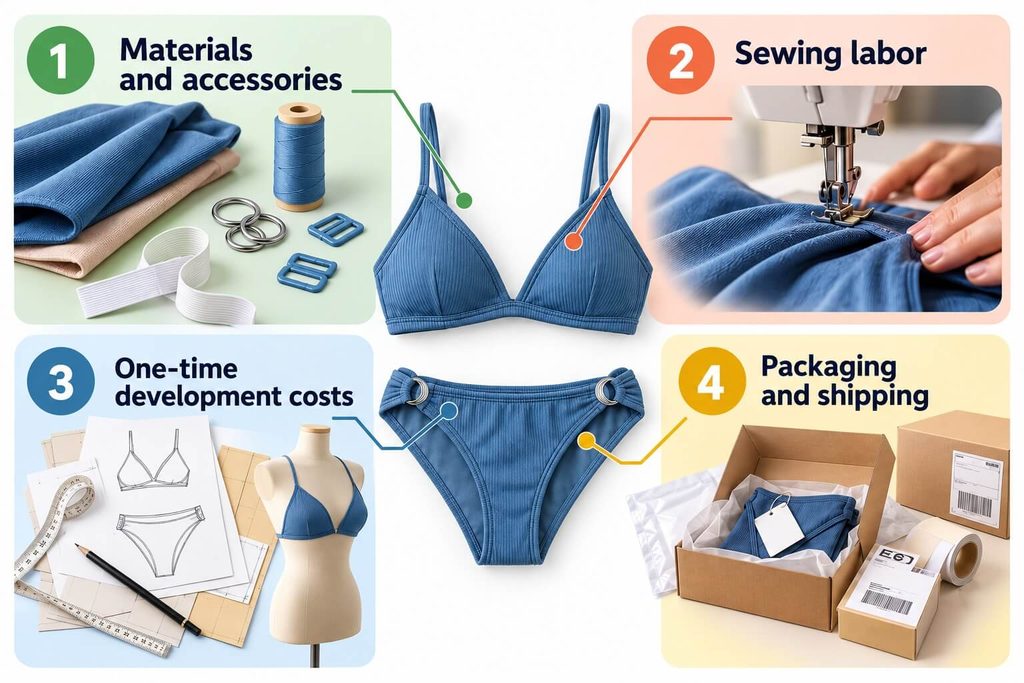
The price per piece is made up of four blocks: material and accessories, sewing labour, one-time development costs for construction, prototype and grading, and packaging and shipping. Only the development share decreases automatically as the series grows; material and sewing labour largely increase with the quantity. The price advantage of larger quantities is therefore often smaller than many expect.
Reorders
In a second production run, most of the development work is no longer needed, because the patterns, grading and approved sample already exist. This changes the calculation. How this affects quantity and price in an individual case, we discuss project by project.
Making use of flexibility: how to shape the minimum quantity cost-effectively
Even with a fixed lower limit, you have an influence on how economical your first series turns out:
- Shared materials: if several models are made from the same fabric, you reach the supplier’s minimum purchase quantity more easily.
- Reduced colour palette: two well-chosen colours cause less effort than five that each run in only a small quantity.
- Standard materials: common fabrics and accessories are usually easier to obtain, and in smaller quantities, than custom-made ones.
- Tight size range: an assortment that is oriented to your target group keeps grading and inventory manageable.
Minimum order quantity for start-ups and young brands
Anyone new to the market rarely has sales figures on which a large initial order can be based. That is why we explicitly support young brands and start-ups that initially want to produce smaller test collections. What matters is an open conversation about goals and budget – then a viable way in can be found.
Fewer models, but well thought out
Instead of ten models in minimal quantities, a few clearly defined pieces in viable quantities are worthwhile. This lowers development costs, simplifies marketing and delivers usable sales data faster.
Scaling step by step
After the sales launch, it becomes clear which models are selling, which sizes are in demand and where the fit needs to be improved. These insights feed into the next, larger series.
Prototype before the series
Before the series is approved, we sew a sample piece that you can review at your leisure. Corrections are inexpensive at this stage, but no longer once a series has been fully sewn.
Documents for the first enquiry
The more specific your enquiry, the faster we can calculate realistically. The following are helpful:
- Sketches, photos or reference products that we can use as a guide
- existing patterns and technical documents, if available
- desired materials and colours
- planned quantity and size range
- target price and desired deadline
How to plan your minimum order quantity
Realistic planning starts with sales, not with the manufacturer’s quote.
- Estimate sales: Pre-orders, retailer enquiries and the reach of your brand show how many pieces you will actually sell in the first season.
- Limit the number of models: The minimum quantity applies per model. The total quantity is the number of models times the quantity.
- Calculate total costs: In addition to the unit price, material, accessories, prototype, packaging and shipping count.
- Check the inventory risk: A higher quantity lowers the price per piece but ties up capital. What matters is what you can realistically sell.
- Allow for time: Prototype, approval, material procurement and production run one after another and need lead time.
Questions you should ask every manufacturer
- Does the minimum order quantity refer to model, colour or size?
- Does the same quantity apply to reorders?
- What minimum purchase quantities apply to fabrics and accessories?
- Which services are included: construction, prototype, grading, packaging?
Typical mistakes
- Starting too many models in very small quantities.
- Comparing quotes only by unit price and overlooking development and material costs.
- Not factoring in the minimum purchase quantities of fabric suppliers.
- Skipping the prototype to save time.
- Setting the quantity according to wishes rather than expected demand.
From enquiry to series – how CANN works
The path to the first series follows fixed steps at our company:
- Consultation: We discuss your vision, inspirations, photos and project details, as well as the right quantity.
- Material selection: We recommend fabrics, knitwear and accessories for finish and wearing comfort.
- Construction and prototype: We create patterns and a sample piece for approval and make corrections until the result is right.
- Grading and pattern optimisation: We transfer the approved model to your sizes and optimise material consumption.
- Cutting, sewing and inspection: Cutting is carried out precisely on our cutting machine, after which our seamstresses sew the series. Every piece goes through quality control and is packed and shipped.
You can find examples of our work under Projects, and more about our company under About Us.
Minimum order quantity and sustainability
Overproduction is a well-known problem in the fashion industry: unsold goods tie up material, energy and labour that were used in vain. A deliberately chosen minimum order quantity is therefore also a sustainability issue. Anyone who produces in stages adjusts the quantity to actual demand.
CANN produces in an environmentally responsible way: we use electricity from photovoltaic systems, rely on environmentally friendly solutions to reduce CO₂ emissions, and keep material waste low through precise cutting. Our aim is durable garments that are worn for a long time.
Conclusion
A realistic minimum order quantity results from the product, the material and the development stage of your brand, not from a fixed number. Anyone who plans the number of models and sales soberly avoids excess stock and keeps the calculation under control.
Do you have a project in mind or already have first sketches? Just get in touch – together we will find a suitable solution. Contact us here.