
Who invented the bra? A brief history of the bra
Who Invented the Bra? This question has probably crossed the minds of many women (and not only women). In today’s blog article, we take a closer look at the history of the bra, its inventors, development, functions, and the fascinating nuances and controversies surrounding it. The article begins with a brief definition of the term, followed by an overview of the main functions of bras, before moving on to their historical background.
What Exactly Is a Bra?
At first glance, the answer seems simple: A bra, short for brassiere, is an underwear garment worn directly against the skin, designed to support, shape, or enhance the appearance of the female breasts. However, upon closer examination, it turns out to be much more than just a functional piece of clothing. It can be considered a true technical achievement in fashion, consisting of numerous perfectly coordinated components such as cups, an underband, straps, and underwires.
From a historical and cultural perspective, the bra is a symbol of the constant evolution of the female body ideal. While today it exists in countless forms – from sporty bralettes to elegant lace designs – its original purpose was revolutionary. It replaced the restrictive corset and gave women a new, previously unknown freedom of movement. The bra is therefore not merely a garment, but also a silent witness to women’s emancipation, placing comfort at the forefront without sacrificing aesthetics.
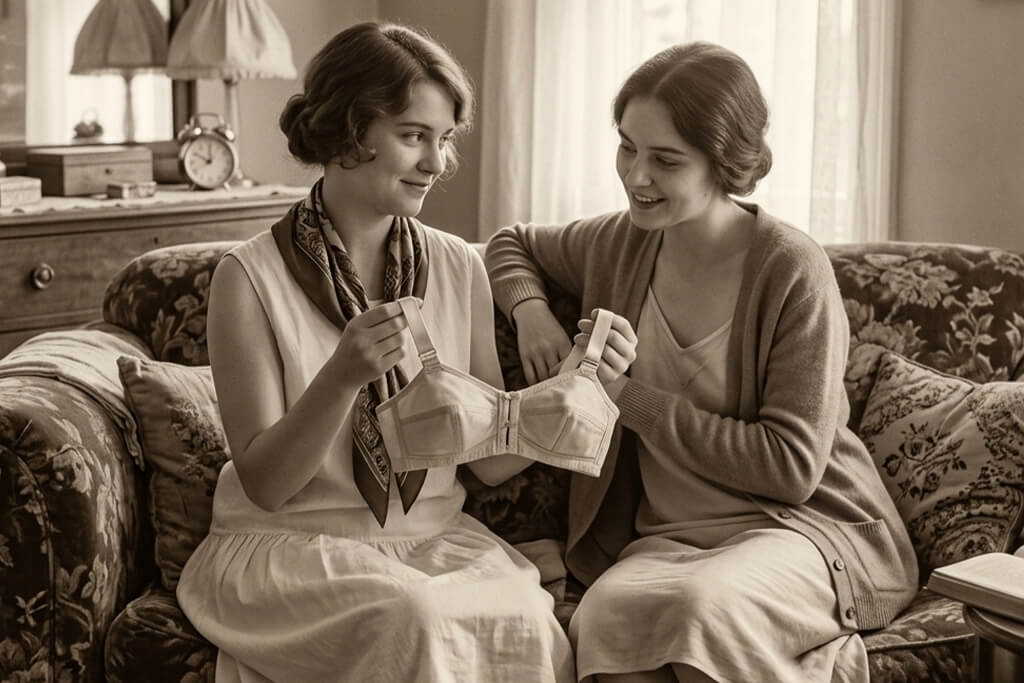
Why do women wear bras? Functions and benefits
The reasons why bras have become a daily companion for millions of women are as diverse as the styles themselves. Today, many modern lingerie manufacturers develop bras that combine comfort, support, and design while being tailored to different needs. While for some people the aesthetic aspect is the main focus, for others a bra is a functional necessity in everyday life or during sports activities. Above all, it is about a combination of comfort, appearance, and well-being. Here is an overview of the most important functions and benefits:
- Relief and support – especially for women with a larger bust, a bra performs an important supporting role. It distributes the weight of the breasts more evenly across the torso and reduces strain on the back and neck muscles, which can help prevent posture problems.
- Protection of connective tissue – the female breast consists mainly of fatty and glandular tissue, supported only by delicate ligaments. A well-fitting bra reduces excessive movement (during sports by up to 75%) and helps protect the connective tissue.
- Aesthetics and shaping – push-up, minimizer, or perhaps balconette? A bra allows women to shape their silhouette according to their preferences and ensures that outerwear such as blouses or dresses fits better.
- Protection and hygiene – as the first layer of clothing, a bra protects sensitive skin from friction caused by rougher fabrics and absorbs moisture, increasing comfort throughout the day.
Whether as a functional “support system” or a fashionable statement, a bra is a versatile garment that helps women feel comfortable, confident, and secure in their own bodies.
What did women wear before the bra?
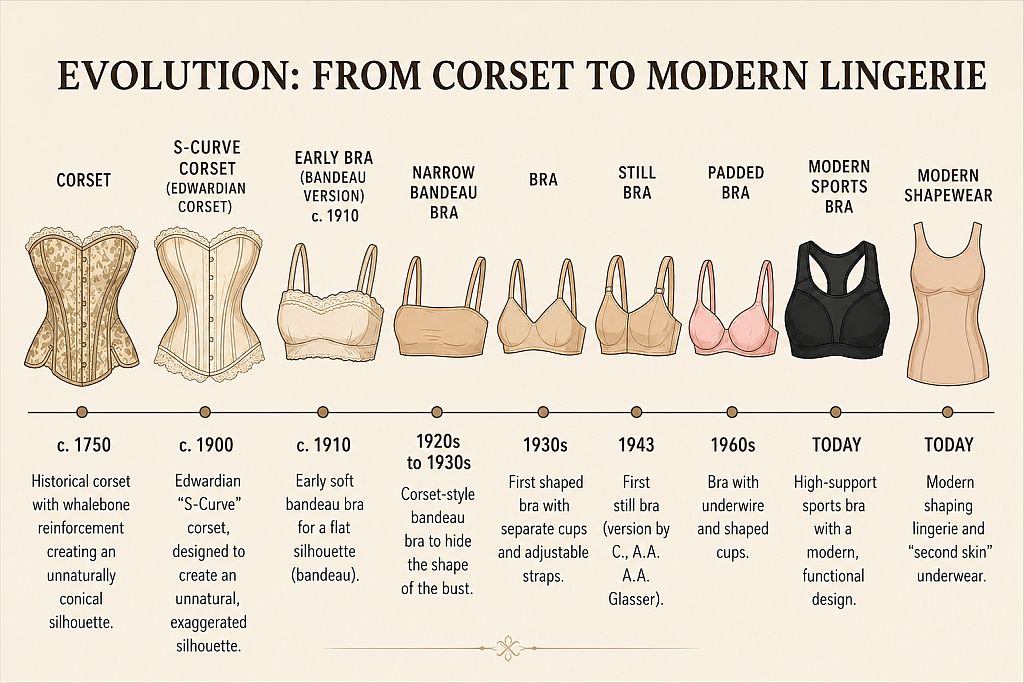
Before the modern bra began its rise, the female silhouette had been literally shaped and restricted for centuries. The dominant garment of the time was the corset. This structured bodice, reinforced with whalebone or steel stays, was designed to support the upper body and dramatically tighten the waist in order to match the beauty standards of the era.
Although earlier predecessors existed, such as the ancient Greek strophium – simple fabric bands wrapped around the breasts – the corset dominated in early modern Europe. However, it was as elaborate as it was impractical: extreme lacing restricted breathing and could even displace internal organs. The desire for greater freedom and comfort beneath clothing therefore continued to grow.
Who invented the bra? A look at the industry’s pioneers
The invention of the modern bra was not a single event, but rather a gradual breakthrough in the movement away from the restrictive corset. At the end of the 19th and beginning of the 20th century, inventors around the world searched for a solution that would support the female breast without constricting the entire upper body.
Different approaches emerged: some aimed to improve women’s health and comfort, while others focused on creating an invisible support garment to wear under modern evening clothing. The following table presents the most important pioneers who helped shape the bra into the garment we know today.
Milestones in the development of the bra
Herminie Cadolle
French designer Herminie Cadolle is considered the woman who literally split the corset in two. At the Paris World Exhibition in 1889, she presented a revolutionary design: “Le Bien-Être” (Well-being). Her creation consisted of two parts: a lower bodice that shaped the waist and an upper section that supported the breasts with shoulder straps. For the first time, she separated waist shaping from bust support. Cadolle was a visionary who recognized that health and comfort would shape the future of women’s fashion. Her company still exists today as a prestigious traditional lingerie house in Paris.
Christine Hardt
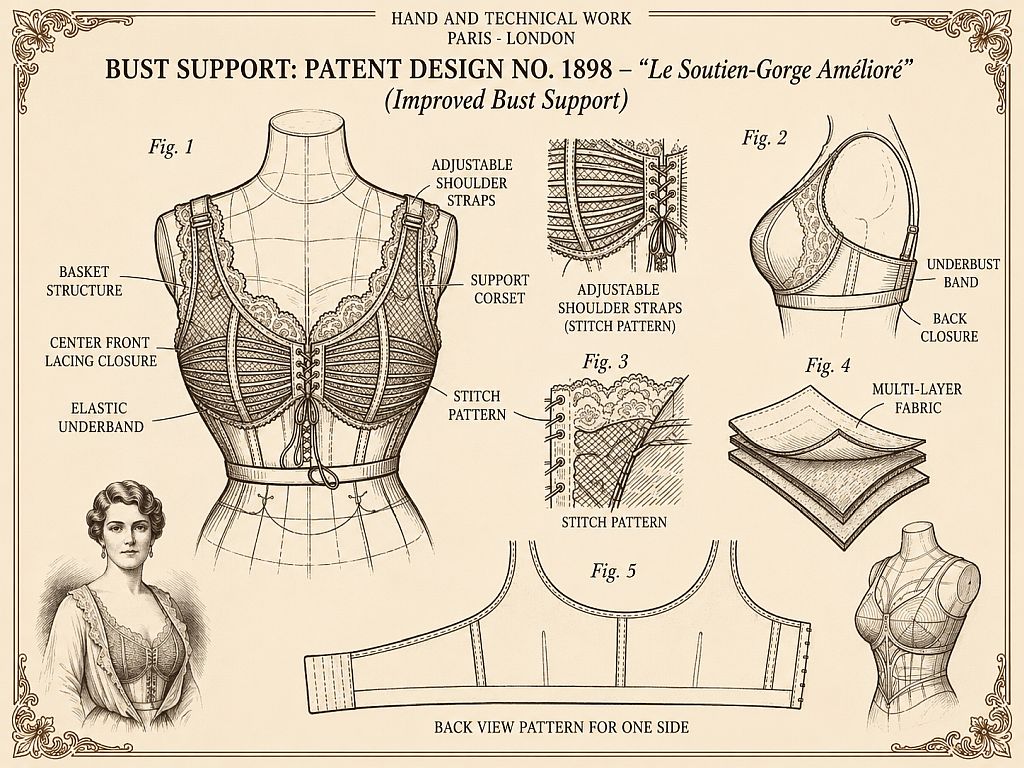
In 1899, Dresden-born Christine Hardt filed a patent for a “women’s bodice as a breast supporter”. Her goal was purely functional: she wanted to create a garment that would support the breasts in a healthy way without restricting them and without relying on bones or steel stays. Her design consisted of sewn fabric pockets and adjustable straps that crossed the back. Hardt laid an important foundation for the modern standard bra and demonstrated that moving away from the corset was also connected to the contemporary health and lifestyle reform movement.
Mary Phelps Jacob (1914)
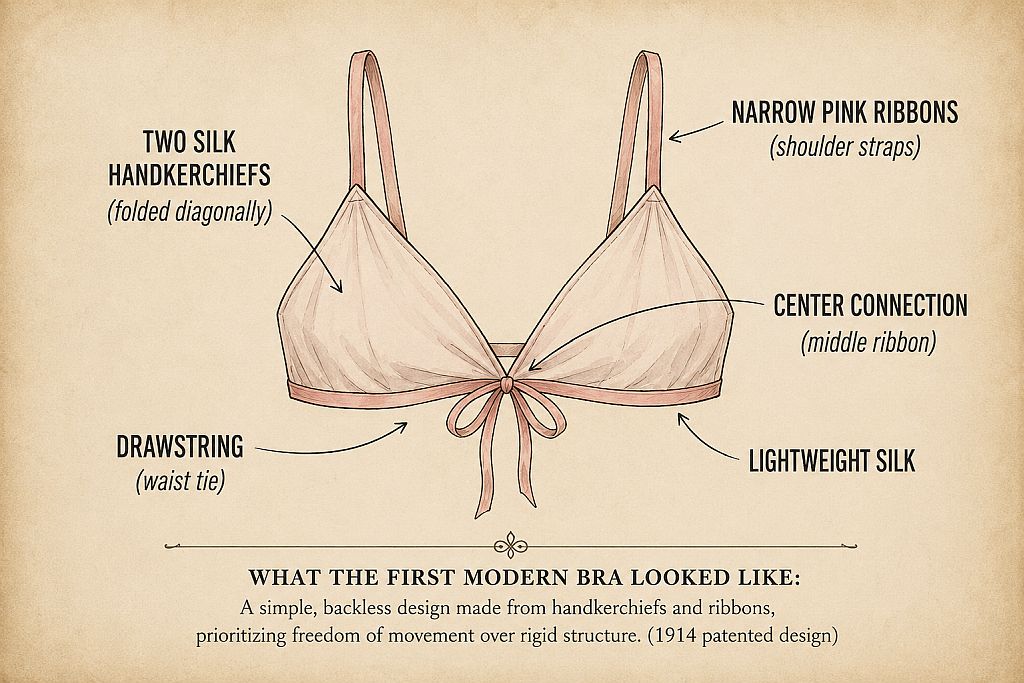
Mary Phelps Jacob, a young New York socialite, invented the bra rather out of necessity. Under her delicate evening dress, the rigid whalebone corset was visibly noticeable and unattractive. She quickly created a lightweight alternative from two silk handkerchiefs and pink ribbons. Her “Backless Brassiere” was soft, flexible, and perfectly suited to the new, flowing fashion of the time. On November 3, 1914, she received the first official patent for a modern brassiere. Although she later sold her invention to the Warner Brothers Corset Company for only $1,500, she went down in history as the mother of the modern bra.
What did the first bra look like?
The “first” modern bra from 1914 had little in common with today’s high-tech push-up bras. It was the result of pure improvisation. Mary Phelps Jacob (also known as Caresse Crosby) simply wanted to wear a low-cut evening dress without the rigid corset showing underneath.
To better imagine the original design, picture two square white silk handkerchiefs folded diagonally and connected at the corners. There were no underwires, no padding, and hardly any shaping. The construction consisted of:
- Two silk handkerchiefs – they served as improvised cups.
- Pink ribbons – one ribbon connected the two pieces, while two others functioned as shoulder straps.
- A drawstring – a ribbon at the bottom was wrapped around the chest and tied securely.
The “Lengberg Castle” discovery – bras already existed in the 15th century?
For a long time, it was believed that the bra was purely a modern invention and that the corset had dominated women’s clothing before it. However, in 2008, a spectacular discovery in East Tyrol challenged this theory. During renovation work at Lengberg Castle, archaeologists uncovered more than 2,700 textile fragments hidden in a vaulted ceiling cavity. Among this medieval “waste” were four linen garments that showed a surprising resemblance to modern bras.
The finds date back to the 15th century, placing them firmly in the Late Middle Ages. One of the pieces looks remarkably similar to a modern longline bra. It features clearly shaped cups, wide straps, and even remnants of lacing holes, suggesting that it was likely fastened at the back or side. Particularly impressive is the fine craftsmanship with lace decoration, indicating that these garments were not only functional but also had an aesthetic purpose.
The Lengberg discovery proves that women were searching for ways to individually support their breasts as early as 500 years before Mary Phelps Jacob, rather than simply flattening them. Why this knowledge disappeared for centuries remains one of the great mysteries of fashion history.
The history of the bra at a glance
The evolution of breast-support garments is a journey from simple fabric bands and restrictive structures to modern textile technology. It reflects not only changing fashion trends but, above all, the perception of women and their bodies in different historical periods. Let’s now take a brief journey through the most important stages of this fascinating development.
Ancient times and the Middle Ages – the first forms of breast support
As early as ancient times, women searched for ways to support and control the breasts during sports and everyday activities. Greek and Roman women used simple fabric bands such as the strophium or mamillare. For a long time, historians believed that this was followed by a period without specific breast support, until the discovery at Lengberg Castle proved that linen garments with clearly shaped cups and straps already existed in the 15th century. These medieval predecessors were surprisingly similar to modern designs before being replaced by rigid outer garments and early bodice forms that shaped the body as a whole.
Corsets in the 19th century
The 19th century was the golden age of the corset. The female silhouette was shaped into an unnatural hourglass figure through whalebone, steel reinforcements, and extremely tight lacing. The ideal was a narrow waist with the breasts pushed upwards. However, these garments were not only uncomfortable but also harmful to health. They restricted breathing and could put pressure on internal organs. Towards the end of the century, resistance began to grow. The “reform clothing” movement demanded greater freedom, and female inventors started separating the corset into two parts to reduce pressure on the waist.
The invention of the modern bra in the 20th century
At the beginning of the 20th century, the final break with tradition took place. Driven by the First World War – when metal was needed for weapons and equipment rather than corset stays – and by the growing desire for freedom of movement, the bra began to gain popularity. Patents by Mary Phelps Jacob and Christine Hardt marked the beginning of this transformation. In the 1920s, the “flapper style” still emphasized a flatter silhouette, but by the 1930s, the natural shape of the female body was being highlighted again. The bra became a mass-produced garment made from silk, cotton, and early elastic fibers, symbolically replacing the restrictive corset and reflecting women’s increasing independence.
The development of bras to the present day
After the Second World War, the variety of bra styles expanded rapidly. The 1950s were dominated by pointed “bullet bras”, the 1960s introduced lightweight and minimalist designs, and the 1990s brought the Wonderbra boom. Today, the bra is a high-tech garment. Thanks to microfiber, memory foam, and laser-cut technology, comfort and functionality are combined more effectively than ever before. From seamless T-shirt bras to highly functional sports bras that significantly reduce movement, modern designs focus on individuality. Today’s bra manufacturers increasingly embrace body positivity and inclusivity by creating styles for different body shapes and needs, while sustainability and eco-friendly materials are becoming increasingly important.
The introduction of cup sizes
A bra can only provide its full benefits when it fits perfectly, but this was not always the standard. In the early days of the bra, many models were available only in universal sizes or based on simple measurements that did not take the actual breast volume into account.
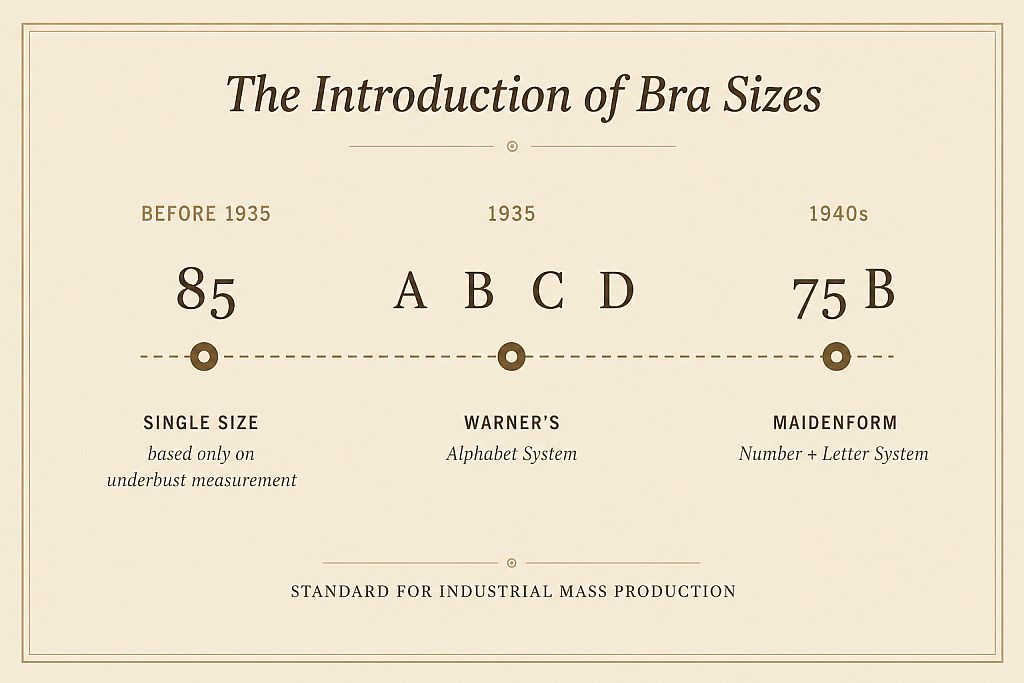
A major turning point came in the 1930s. In 1935, the US company Warner’s introduced the “alphabet system” for cup sizes. Before this, sizing was mainly based on the underbust measurement. However, women with the same underbust circumference can have completely different breast volumes. Warner’s initially introduced cup sizes A to D to define the cup separately from the band size.
In the 1940s, Ida Rosenthal, the founder of Maidenform, further developed this concept. She recognized that an individual fit was the key to success. By combining the underbust measurement (number) with the cup size (letter), the bra became the precise and customizable garment we know today. This standardization made industrial mass production possible while allowing millions of women worldwide to find bras adapted to their individual body shapes.
Interesting facts about the invention of the bra
Behind the development of the bra are often fascinating stories that go far beyond simple fashion trends. Did you know, for example, that global politics had a direct influence on women’s underwear? Here are some intriguing facts:
- The origin of the word “brassiere” – The term comes from the Old French word referring to a type of arm protector. Around 1907, Vogue magazine helped popularize the word to distinguish the new breast-supporting garments from traditional corsets.
- A war-related invention! – During the First World War, the US government encouraged women to stop buying corsets. The reason: the metal used for corset stays was needed for building warships. This saved enough steel to construct two battleships and helped accelerate the rise of the bra.
How has the bra changed until today?
Over the past decades, the bra has evolved from a purely shaping garment into a high-tech product. While earlier designs relied on rigid seams and heavy fabrics for underwear, modern manufacturers use seamless construction (laser-cut technology) and innovative materials such as memory foam, which adapts individually to the body through body heat.
However, the greatest transformation has taken place in the philosophy behind the product itself. The focus has shifted away from simply creating a visual enhancement toward maximum comfort and inclusivity. Today, brands offer a wide range of shades and sizes, while functional features such as breathability and sustainable fibers are becoming increasingly important. The modern bra is therefore a combination of aesthetic design and biomechanical support.
Our conclusions on the development of bras
The journey of the bra – from the first linen garments discovered at Lengberg Castle, through the silk handkerchief design of Mary Phelps Jacob, to today’s highly advanced manufacturing processes – is far more than just a story of fashion. It is an impressive reflection of technological progress and social change. The bra has evolved from an instrument of restriction into a symbol of freedom, comfort, and individual self-expression.
Today, the focus is no longer on rigid beauty standards, but on the combination of health, functionality, and aesthetics. Modern manufacturers, such as the Polish sewing company Cann Näherei, demonstrate how traditional craftsmanship and digital precision can work together to create the perfect support for every woman.
Understanding the history and technical requirements behind this garment allows us to appreciate the important role the bra continues to play in everyday life.
FAQ – Frequently asked questions about the invention of the bra
Mary Phelps Jacob is generally considered the inventor of the modern bra, as she developed a lightweight alternative to the corset.
The first modern bra was patented in the United States in 1914.
The goal was to provide greater comfort, freedom of movement, and a more natural silhouette compared to the restrictive corset.
Not in the modern sense, but simple breast bands and fabric-based predecessors did exist.
Women mainly wore corsets that shaped the upper body, as well as loose undergarments.
Mary Phelps Jacob is regarded as the creator of the modern bra, although earlier forms of breast support existed.
It has evolved from simple fabric constructions into technically advanced products designed for precise fit and individual needs.
A corset shapes the entire upper body, while a bra primarily supports the breasts.
Standardized cup sizes were introduced in the 1930s, significantly improving bra fit.
Changing fashion trends, increasing demand for comfort, and industrial production made bras suitable for everyday wear.
It was lighter, less restrictive, and offered greater comfort and freedom of movement.
Yes, the modern bra is based on the invention of Mary Phelps Jacob.
Fashion shaped its cuts, materials, and functions – from strong shaping garments to designs focused on natural comfort.