Clothing Production in China vs. Production in Poland
The decision for the right clothing production location is rarely just a matter of numbers. For many brands, it starts much earlier – with one fundamental concern: Will this product really look, feel, and perform the way I envisioned it?
This question is especially important when it comes to underwear and swimwear. It is not only about fabrics and cuts, but also about fit, confidence in the workmanship, and whether a collection ultimately delivers on the promise made in the design phase. Even small deviations can determine whether a product is worn – or returned.
At some point, many companies face the same strategic decision: production in China or production in Europe, for example in Poland. On one side are scalability and lower unit costs; on the other are proximity, control, and speed during the development process.
What may appear to be a simple cost decision on paper quickly becomes a much broader question in practice: How much risk is a brand willing to accept – and how closely does it want to stay connected to its product?
This comparison shows where the real differences can be felt – not only in figures, but throughout the entire process, from the first idea to the finished collection.
Overview – Textile production in China and Poland compared
Textile production in China and Poland differs not only on a technical level but, above all, in the way brands manage the entire manufacturing process. Both locations offer clear advantages, but they create very different working realities depending on a brand’s size, speed, and expectations.
Comparison overview – China vs. Poland
At first glance, both production locations may seem directly comparable. In practice, however, significant differences become visible – not only in costs and processes, but above all in how much control, proximity, and flexibility a brand can maintain in its daily operations.
Production costs comparison – Asia vs. Europe
At first glance, the cost question seems straightforward: China stands for low unit prices, while Europe is associated with higher production costs. In practice, however, the final decision is rarely based on the price per piece alone. What matters is the entire cost structure of a collection.
Production involves much more than manufacturing itself. Product development, sampling, communication, logistics, customs, and possible adjustments all need to be included in the calculation – and these are often the areas where the real differences emerge and ultimately determine profitability.
In China, production costs per unit are often significantly lower, especially for large quantities. At the same time, additional factors may arise that only become visible during the process: longer transport routes, more complex coordination, customs procedures, and the costs of correction rounds if a product is not implemented perfectly from the beginning.
European production – for example in Poland – follows a different calculation model. Although unit costs are usually higher, the entire process becomes more predictable. Shorter distances, direct communication, and lower logistical complexity reduce uncertainty. For many brands, this does not necessarily mean a lower price, but rather a stable and controllable cost structure – especially for small and medium-sized collections.
Quality and workmanship in underwear and swimwear production
When it comes to underwear and swimwear, the focus is not on simple cuts or standard manufacturing. Every millimeter can determine whether a product fits perfectly – or simply does not work in everyday use. This product category leaves no room for mistakes because it is worn directly on the body and must combine comfort, support, and appearance at the same time. For this reason, specialized underwear manufacturers play a crucial role in ensuring consistent quality and precise execution.
This becomes particularly clear with swimwear: highly elastic materials such as elastane or modern sustainable fabrics like REPREVE® must not only look attractive but also remain durable over time – in chlorinated water, salt water, and during constant movement. Seams must not cause irritation while still being extremely resistant. Special production techniques such as flatlock seams are often required, and these can only be executed properly with the right expertise and equipment.
With underwear, the challenge lies in a different area – often invisible, but equally important. Fine lace, elastic bands, and skin-friendly materials must be processed in a way that feels natural while maintaining their shape over time. Even small inaccuracies in cutting or sewing can affect the entire fit of a garment.
Ultimately, one thing becomes clear: the quality of a collection is not determined by the design alone, but by the precision of its execution – and by the technical expertise hidden in every single seam.
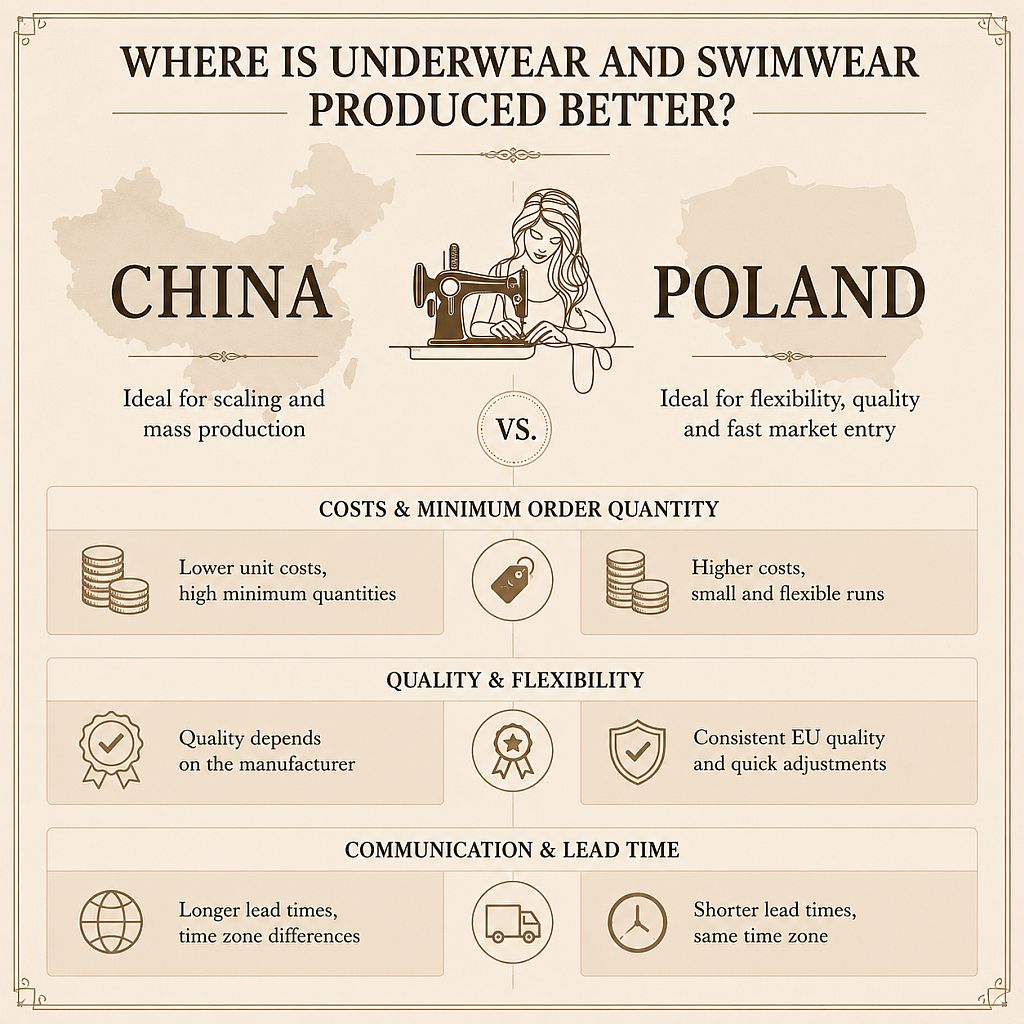
Comparison of clothing production – China vs. Poland (Quality and workmanship)
When it comes to underwear and swimwear, the difference between the two production locations becomes particularly visible. For many brands working with a swimwear manufacturer, the focus is not only on technical standards but also on how consistently a product can be implemented in practice – from the first prototype to full-scale production.
Minimum order quantities (MOQ) and flexibility
The question of minimum order quantities may seem technical at first glance – but in practice, it often determines whether a collection can be realistically produced at all. For many new brands in the underwear and swimwear industry, this is frequently the first major challenge.
In reality, this means that China works particularly well when a product has already been validated and needs to be scaled in large quantities. For early development phases or new collections, however, this approach can involve greater risks, as high minimum order quantities leave little room for testing and adjustments.
European production – especially in Poland – offers greater flexibility throughout the process. Brands can start with smaller series, test designs, and only scale up once market feedback is available. Particularly in sensitive product categories such as underwear and swimwear, this approach not only reduces financial risk but also lowers the pressure during the development phase.
Communication and product development
Besides costs, quality, and minimum order quantities, one much less visible factor often determines the success of a collection in practice: communication throughout the development process. Especially in underwear and swimwear production, where even the smallest details influence fit and comfort, every stage of coordination can affect the final product.
When working with manufacturers in China, this process often involves several levels of communication. Questions, adjustments, and feedback are not always implemented directly where the decisions are made. As a result, simple corrections may require more steps and more time than originally expected. The development process can therefore feel less like a direct exchange and more like a sequence of forwarded requests.
In European production – for example in Poland – this process is usually much shorter. Decisions can be made more directly, feedback is implemented faster, and samples can be adjusted without lengthy communication loops. This changes not only the speed but also the way a collection is created: less distance, more direct influence on the final result.
Ultimately, this is where one often underestimated difference becomes clear: how closely a brand can truly stay connected to its product – and how many steps separate the original idea from the finished result.
Delivery times and time-to-market
Besides costs, quality, and communication, one factor often plays an even more decisive role in practice: time. In the fashion industry – especially in underwear and swimwear – collections are closely linked to seasons, trends, and sales windows. When a product arrives too late, a brand does not only lose time but often also a significant part of its market potential.
In production in China, the entire process is extended by several factors: production planning, coordination, manufacturing, international transportation, and customs procedures. Between final sample approval and actual delivery, many weeks – and sometimes even months – can pass. The result is a clearly structured but less flexible process in which decisions must be made early and later adjustments are only possible to a limited extent.
In European production – for example in Poland – the timeline is usually much shorter. Shorter transport routes within the EU, more direct communication, and fewer administrative steps allow products to move from prototype to series production faster. For brands, this primarily means one thing: greater responsiveness. New trends, design adjustments, or short-term collections can be implemented more quickly without having to restart the entire process.
Ultimately, time becomes a strategic factor. Not only because it affects costs – but because it determines whether a collection reaches the market at the right moment or misses a crucial trend.
Sustainability and responsibility in production
Sustainability in the fashion industry is no longer just a marketing topic. For many brands, it has become a question of credibility – and for customers, often a quiet but important decision factor. Especially in underwear and swimwear, where products are worn directly on the skin, the origin of materials, production conditions, and supply chain transparency are becoming increasingly important.
China
- Sustainability depends heavily on the individual manufacturer and their standards
- Significant differences in environmental regulations and certifications throughout the supply chain
- Higher CO₂ emissions due to long transport distances
- Additional effort required for audits, inspections, and external quality controls
- Full supply chain transparency is often more difficult to achieve
Europe (Poland / EU production)
- Clearly defined environmental and production regulations within the EU
- Shorter transport routes and therefore reduced logistics-related emissions
- Better traceability of materials and production processes
- Easier monitoring and documentation throughout the supply chain
- Overall more structured and transparent production framework
Ultimately, sustainability is not only about values or labels, but about how traceable a product actually is – step by step, from material selection to the finished garment.
When is which type of production really worthwhile?
Ultimately, choosing between China and European production is not purely a technical decision – it is a question of strategy, risk, and the speed at which a brand wants to grow. Each stage of a company’s development creates different requirements.
China is particularly worthwhile when processes are already established and the goal is large, predictable production volumes. The focus is clearly on scaling and achieving the lowest possible unit costs with standardized products.
Europe – especially Poland – becomes more relevant when flexibility is a priority: new collections, shorter development cycles, or brands that are still building their position and need to respond quickly to market feedback.
For premium and sustainability-focused brands, proximity to production is also an important factor – not only for logistical reasons but also for quality control and communication. Decisions can be made more directly and implemented faster.
Start-ups benefit above all from one key advantage: lower risk. Smaller minimum order quantities and faster adjustment options ensure that mistakes do not become overly expensive and that product development can happen through an iterative process.
In the end, the question is not simply “Where is production cheaper?” but rather how much control, speed, and security a brand truly needs throughout the manufacturing process.
Conclusion – clothing production in Asia vs. Production in the EU
The decision between Asia and Europe is rarely a question of right or wrong – it is rather a strategic choice closely connected to a brand’s positioning and long-term goals.
Asia, particularly China, stands for scalability, optimized unit costs, and large production volumes. This approach works especially well for established brands with clearly defined processes, stable demand, and a strong focus on efficiency in mass production.
EU production locations, such as Poland, focus instead on proximity, speed, and flexibility. They enable shorter development cycles, more direct communication, and lower risks for smaller production runs – factors that are particularly important for growing brands and dynamic collections.
This difference becomes especially visible in sensitive product categories such as underwear and swimwear. Today, the decision is no longer only about the price per piece, but about how quickly and reliably an idea can be transformed into a market-ready product.
For many brands, this becomes the decisive factor – and this is exactly where modern European production partners such as Cann Näherei create value by bringing product development, flexibility, and manufacturing closer together.
FAQ – Textile production in China vs. Europe
Not necessarily. While unit costs are often lower, the overall calculation must also include transportation, customs, longer delivery times, and possible adjustments or corrections. In many cases, these additional factors significantly reduce the actual cost advantage.
No. Smaller labels and start-ups often benefit greatly from European production locations such as Poland, as lower minimum order quantities, faster communication, and more flexible development processes make entering the market easier.
It strongly depends on the brand’s strategy. China is particularly suitable for standardized products produced in large volumes, while Europe offers advantages in terms of fit, development speed, and flexible implementation – especially when working with demanding materials and complex designs.
They are very important because they directly influence the financial risk of a collection. High MOQs in China usually require confirmed market demand in advance, while European production allows more room for testing, adjustments, and smaller series.
An increasingly important one. Beyond brand image and customer expectations, sustainability is mainly about transparency, transport routes, and traceability. Shorter supply chains and stricter EU standards often make European production easier to monitor and document.